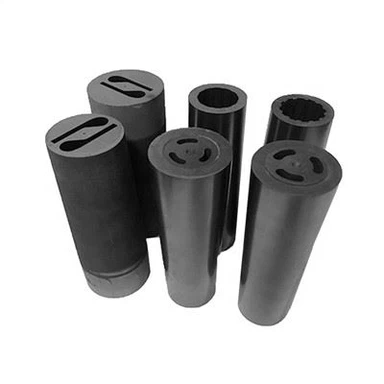
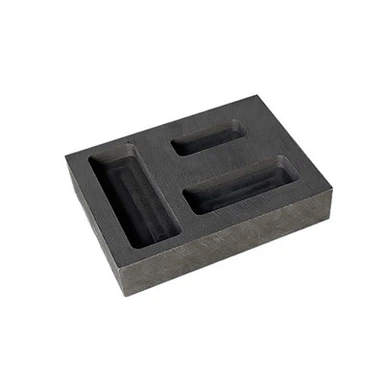
Graphite mold is widely used
Feb 23, 2024
Mold is a very widely used basic process equipment in industrial production, mold industry is the basic industry of national economy. In modern industrial production, product parts are widely used in stamping, forging forming, die-casting forming, extrusion forming, plastic injection or other forming processing methods, which are matched with forming molds to make billet forming and processing into parts that meet product requirements. All kinds of tools and products used in our daily production and life, as large as the base of the machine tool, the body shell, as small as a blank head screw, buttons and the shell of various household appliances, are closely related to the mold. The shape of the mold determines the shape of these products, and the processing quality and precision of the mold also determine the quality of these products. In recent years, the rapid development of the mold industry, graphite materials, new processes and increasing mold factories continue to impact the mold market, graphite with its good physical and chemical properties has gradually become the preferred material for mold production.
Excellent performance of graphite mold
1. Excellent thermal and electrical conductivity 2. Low coefficient of linear expansion, good thermal stability and heat shock resistance 3. Chemical corrosion resistance and most metals are not easy to react 4. At high temperatures (most copper matrix sintering temperature above 800℃) the strength increases with the increase of temperature 5. 6. Easy to process, good machining performance, can be made into a complex shape, high precision mold
At present, graphite molds have been widely used in the following aspects:
1. Graphite mold for continuous casting and semi-continuous casting of non-ferrous metals: In recent years, advanced production methods such as direct continuous (or semi-continuous) manufacturing of bars or pipes from the molten metal state are being promoted. This method has begun to be used in copper, copper alloys, aluminum, aluminum alloys, etc. Artificial graphite is considered to be the most suitable material for continuous casting or semi-continuous casting of non-ferrous metals. Production practice has proved that due to the use of graphite mold, due to its good thermal conductivity (thermal conductivity determines the solidification rate of metal or alloy), the self-lubrication performance of the mold is good and other factors, not only the casting speed is improved, but also because the size of the ingot is accurate, the surface is smooth, and the crystallization structure is uniform, it can be directly processed in the next process. This not only greatly improves the finished product rate, reduces the waste loss, and the product quality has also been greatly improved. There are two continuous casting methods: vertical continuous casting method and horizontal continuous casting method.
2. Pressure casting mold: Artificial graphite materials have been successfully used for pressure casting of non-ferrous metals. For example, zinc alloy and copper alloy castings produced by pressure casting molds made of artificial graphite materials have been used in automotive parts and so on.
3. Graphite mold for centrifugal casting: graphite mold has been successfully applied to centrifugal casting. The United States has used artificial graphite casting mold with wall thickness of more than 25 mm to centrifugally cast bronze casing. In order to prevent the burning of artificial graphite mold, certain anti-oxidation measures can be taken. After casting a certain number of castings, if the inner surface of the mold is found to be burned, the size of the hole in the mold can be enlarged for casting large casing.
4. Hot pressing die: artificial graphite hot pressing die for cemented carbide pressure sintering has the following characteristics: First, if the pressing temperature is increased to 1350-1450 degrees, the required unit pressure can be reduced to 67-100 kg force/square centimeter (that is, 1/10 of the cold pressing pressure); Second, pressure and heating are carried out in the same process, and dense sintered bodies can be obtained after a short time of sintering.